


Framework & Approach
A Prevention Science Framework for Trauma-Informed Workforce Development
PREVENTION FRAMEWORK FOR TRAUMA-INFORMED WORKFORCE DEVELOPMENT
Author: Aaron Johnson, MS
Affiliation: Johnson Mapenzi Consulting Group (JMCG)
Institution: University of Cincinnati, Community Health & Prevention Science
Year: 2025
This research-to-practice framework translates prevention science principles into actionable strategies for workforce development systems. JMCG implements this framework across organizational consulting engagements.
Most workforce development operates from a scarcity model: get people employed quickly, measure success by placement rates, move resources to the next cohort.
This approach assumes employment itself is curative, that a paycheck will solve the accumulated effects of chronic stress and systemic harm.
But economic mobility without healing is just moving trauma from one zip code to another.
Research shows that adults with 4+ adverse childhood experiences (ACEs) are 2.5 times more likely to experience unemployment. These aren't character flaws; they're predictable, patterned responses to harm that workforce programs routinely pathologize as "soft skill deficits.
The Core Insight
“Workforce development that ignores trauma doesn’t develop a workforce; it extracts labor from people who are still trying to survive.”
The Problem
The Problem: Traditional Models Extract Labor Without Building Capacity
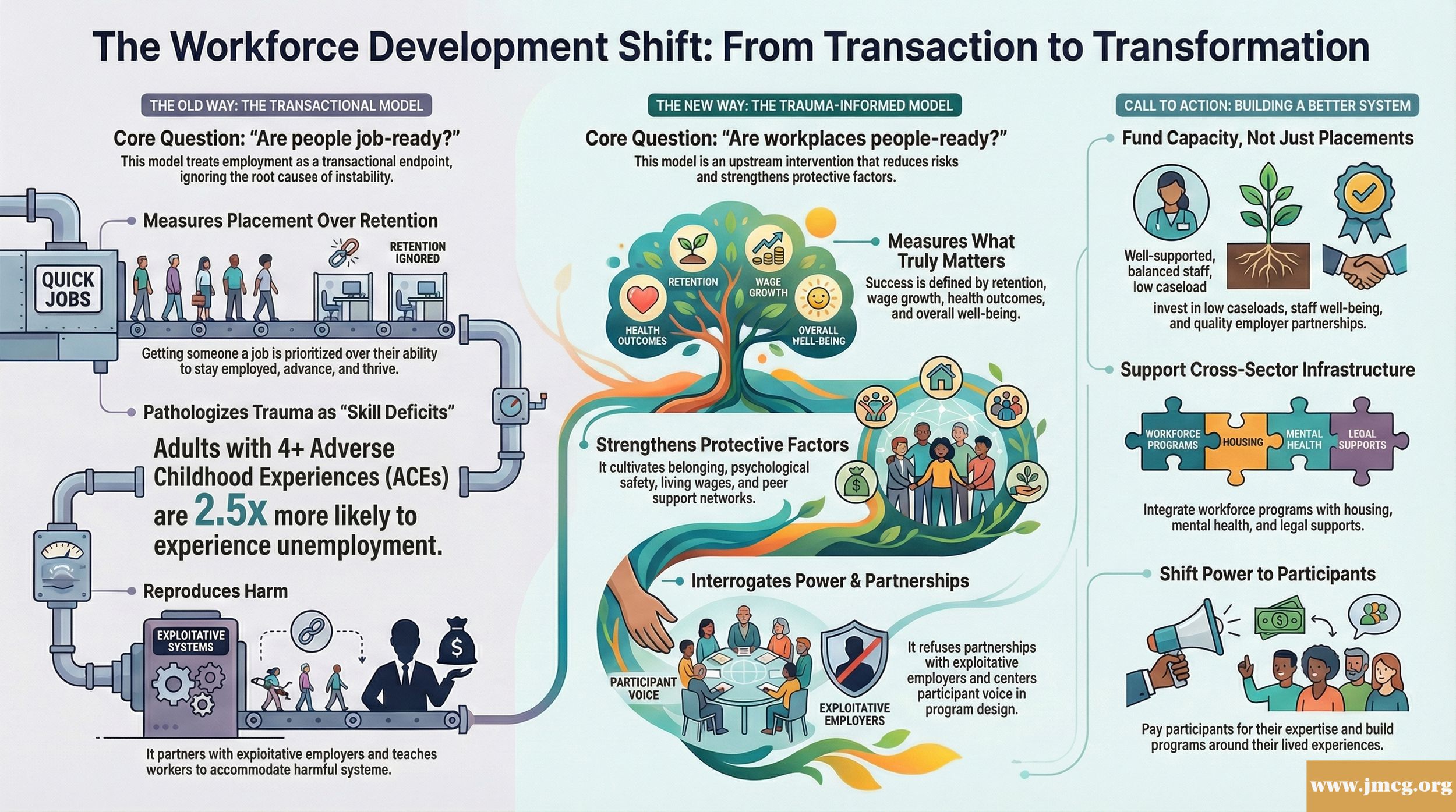
Our prevention framework systematically reduces risk factors while
strengthening protective factors at three levels: program, workplace,
and systems.
The Framework: Upstream Prevention Through Trauma-Informed Systems Practice
REDUCE RISK FACTORS
Program Level:
- Burnout among staff and participants
- Punitive, surveillance-based cultures
- Partnerships with exploitative employers
Workplace Level:
- Chronic stressors (wage theft, discrimination)
- Control-based management
- Absence of worker protections
Systems Level:
- Benefits tied to employment (coercive)
- Structural barriers programs can't address alone
- Quality jobs concentrated in credentialed fields
STRENGTHEN PROTECTIVE FACTORS
Program Level:
- Belonging and relational safety
- Supportive, non-coercive coaching
- Peer cohorts and mutual aid
Workplace Level:
- Living wages and comprehensive benefits
- Participatory cultures with advancement pathways
- Accommodation of caregiving and health needs
Systems Level:
- Decouple survival needs from employment
- Investment in care infrastructure
- Cross-sector partnerships addressing root causes
WHAT THIS LOOKS LIKE IN PRACTICE
- See people as whole (not just job seekers)
- Build trust over time through consistency
- Interrogate partnerships (refuse exploitative employers)
- Treat organizational culture as intervention
- Measure what matters (retention, health, well-being)
Evidence from 15+ Years of Practice
-
Community-Rooted Workforce Support Facilitated trauma awareness training for young adults transitioning to employment. Within 6 months, participants were more willing to disclose challenges, better able to identify workplace triggers, and more engaged in peer support networks.
-
Violence Prevention as Workforce Intervention
Led $2M initiative building 60+ partner network to reduce youth violence
in South Atlanta. Connected opportunity youth with trauma-informed career
coaching and paid internships.
Outcome: 25% reduction in youth violence incidents over two years—not
through enforcement, but through creating stable economic pathways.
-
Centering Dignity in Reentry Workforce Services
Supported 16-24 year-olds transitioning from incarceration with flexible
programming, living wage partnerships, and peer cohorts.
Outcome: Lower placement rates than traditional models, but significantly
higher retention at one year and meaningful improvements in health and
housing stability.
-
Organizational Culture as Prevention
Co-facilitated leadership retreat on conflict transformation and relational
safety.
Participant feedback: "You created a calm, safe space for us to connect,
reflect, and be seen. I truly felt seen... You not only said you work
under the ethos of seeing someone but also modeled it by living it with
the group."
Downloads & Resources
Ready to implement trauma-informed practice in your organization?
Whether you're a funder looking to shift investment strategies, a program leader building capacity, or an organization committed to centering healing alongside economic mobility, this framework can guide your work.
Let's talk about what trauma-informed workforce development looks like in your context.